
In second grade, everyone I knew—myself included—was obsessed with these stuffed animals called Webkinz. Webkinz came with online access codes that could be used to create a profile for your plush toy on the Webkinz website, where you could play games, design your animal’s house, and interact with other users. For years, I begged my parents to buy me a Webkin, but they always said no because the stuffed animals were expensive. It was only by the time I was in fourth grade that my begging finally paid off: my parents agreed to let me pick out one Webkin for my tenth birthday.
Webkinz sold a variety of animals, from more common mammals like dogs and bears to exotic ones such as platypuses, snakes, and penguins. To this day, I still don’t know why, but out of the myriad options available to me, I ended up choosing a koala. I named my koala Ben (naturally) and he quickly became my favorite toy. It was because of Ben that, over time, the koala also became my favorite animal.

An example koala Webkin, similar to the one I had as a child, found on amazon.com.
What I like most about koalas is actually how misunderstood they are. Colloquially, people tend to refer to koalas as “bears,” but they actually bear—pun very much intended—no direct evolutionary relation to grizzly bears or polar bears. Bears, like humans, are placental mammals, also known as eutheria, to use the fancy biological term. Placental mammals produce offspring that complete their initial development entirely in the uterus and, as such, are born at a fairly advanced stage of development. In contrast, koalas are marsupials (metatheria). They give birth to underdeveloped young, who then spend the next several months completing their remaining development in a pouch attached to their mother. In other words, koalas are more closely related to kangaroos than they are to bears, despite having physical features that look more like the latter.
I think there’s something relatable in having an appearance that doesn’t necessarily match your identity. In my own experience, people often ask if I identify as Latino, citing my tan skin and dark hair as clues to a potential Hispanic ancestry. In reality, however, my family is Jewish and Eastern European, primarily from Russia and Ukraine. For me, the mismatch between identity and appearance is related to ethnicity, but a similar phenomenon for some individuals could be related to age, sexuality, gender, race, or many other characteristics. Koalas, I believe, are a testament to how our identities can so easily be oversimplified by stereotypes that take into account only surface-level features of otherwise deeply complex traits. How others perceive us— and koalas, for that matter— is not always the truth.
Then, there’s also the fact that a lot of people think of koalas as cute and cuddly dolls, when, in reality, they can actually be fairly aggressive when they need to be. Koalas have sharp claws—adapted for efficient tree climbing—and can bite when threatened. Like most animals, koalas won’t actually attack unless they feel unsafe or provoked, but they certainly aren’t passive toys waiting to be pet and hugged by overeager tourists. I think there’s something pretty bad-ass about koalas in that sense: they’re adorable most of the time, but they’re also strong enough to protect themselves when they need to be.
Despite their evolutionary distance from humans and other placental mammals, koalas actually have fingerprints just like humans. In fact, the only other animals with fingerprints are gorillas and chimps, both of which share clear evolutionary connection to humans. Biologists believe that koalas evolved to have fingerprints independently of primates, especially since close relatives of the koala, such as kangaroos and wombats, don’t have them. Fingerprints are theorized to allow for greater precision in moving and sensing objects—an evolutionary advantage that would be useful for koalas when grasping eucalyptus leaves and for humans when handling tools, food, or other objects.
Koalas are fascinating, at times enigmatic, creatures, but unfortunately, their population is rapidly declining in Australia. A large part of this is due to human activity; cars and house pets often kill koalas, while human expansion into forests has severely destroyed hundreds of acres of koala habitat.
Climate change in recent decades has also contributed to the problem. Australian forests have become hotter and drier, which, in turn, has started to dry out eucalyptus leaves, a koala’s main source of food and water. Koalas have unique adaptations that allow them to go long periods of time without drinking much water. For instance, they don’t expend much energy, sleeping upwards of 18 hours a day, and their fur retains water very well. However, with the drying out of eucalyptus leaves, koalas have struggled in recent years to obtain enough water to survive in an increasingly arid climate. That’s why some tourists—particularly cyclists with water bottles attached to their bikes—have even reported being approached in the street by thirsty koalas that climbed out of their trees to beg for water. This is especially surprising because, until fairly recently, it was believed that koalas in the wild did not need to drink free water, only water from inside eucalyptus leaves. Koalas, therefore, serve as an interesting example of how large-scale changes in climate can contribute to changes in animal behavior, as well. Thankfully, wildlife experts have begun setting up water wells for koalas, which seem to be working as an effective supplement.
Besides human activity and climate change, however, there’s also the chlamydia problem. In recent years, koalas have suffered especially high rates of infection from the sexually transmitted disease chlamydia, a bacteria that also infects humans. Chlamydia in and of itself is not necessarily deadly, but it does weaken the immune system of infected koalas, which, coupled with other stress, such as dehydration, can have detrimental effects. Chlamydia in humans, if caught early, can be pretty easily treated with antibiotics. Koalas can also be treated with the same antibiotics, but one major challenge is that human antibiotics seem to interfere with the koala gut microbiome, throwing off the balance of “good” bacteria in the koala digestive tract that are necessary for eucalyptus leaf digestion. Ongoing research is being conducted on ways to selectively destroy the chlamydia bacteria, while preserving the beneficial gut bacteria koalas need to survive.
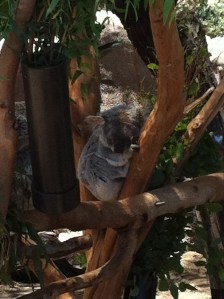
A photo I took of a koala at the San Diego Zoo when I visited in June 2012.
I got my first koala stuffed animal in 2008, and in 2012, I was fortunate enough to see a koala in real life for the first time at the San Diego Zoo. Since then, I have been incredibly fascinated by these unique marsupials. One day, I hope to be able to visit Australia to see koalas in person in their natural habitat. For that to happen, though, significant conservation measures will need to be put in place in order to ensure the survival and thriving of koala populations amid climate change and forest disruption. Further research into koala behavior, diet, and physiology must also be made a priority.
 On Ariel's Mind
Beautifully said about beautiful animals!
>
LikeLiked by 1 person