
It’s hard to believe that I’m done with another semester and another year of college already. Thursday was my last day of junior year, which is crazy because it means I only have one more year of undergrad left to go!
At the end of a semester, I think it’s always a good idea to take time to reflect on the growth you’ve achieved. This semester was filled with a lot of new projects—I joined a lab in preparation for writing my senior thesis, for example—but also the finishing up of some long-term endeavors, including Orgo and the final class I needed for my Statistics minor. This blog post is dedicated to sharing some of the new things I learned along the way as semester number six came to a close.
What I learned in boating school—I mean, Harvard—is…

Meme found here.
1. Cranberry juice cocktail is apparently really bad for you.
Since freshman year, my favorite beverage at the dining halls has always been “cranberry cocktail.” I used to drink at least one glass with every meal, for a total of roughly 3-4 glasses of the juice per day.
I always thought cranberry juice was pretty healthy—or at least healthier than most of the other beverage options. It’s made with fruit, after all, and I had previously heard that cranberries were good for preventing urinary tract infections and supporting prostate health. Then, one day, I saw this sign in the d-hall:
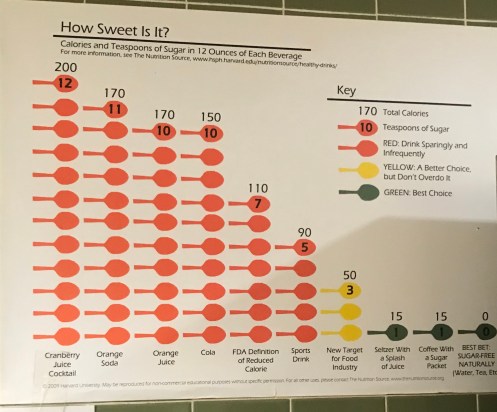
Apparently, cranberry cocktail has 200 calories and 12 teaspoons of sugar in each 12 oz. serving. That’s 50 more calories than Coke and 2 more teaspoons of sugar.
Turns out, cranberry cocktail is actually the least healthy of all the dining hall beverages, worse even than Coke and other sodas. But how was I so wrong about my beloved cranberry drink?
Apparently, there’s a difference between cranberry juice and cranberry cocktail. Cranberries are naturally very tart, so to make them more palatable as a juice, vendors will often add additional sugar. In cranberry juice, this sugar usually takes the form of other fruits, such as apple or grape, added to the drink; cranberry juice, therefore, isn’t purely cranberry. Cranberry cocktail, on the other hand, is solely cranberry, but with lots of sugar (sometimes even high fructose corn syrup) added. Thus, while entirely unsweetened cranberry juice is great for you and sweetened cranberry juice with other fruits mixed in is an okay choice, cranberry cocktail is actually quite unhealthy.
Since learning this, I’ve switched to drinking only water in the d-hall. I do treat myself to an occasional cranberry cocktail from time to time, but I certainly don’t drink 3-4 cups a day like I used to.
2. Organic Chemistry is really hard, but sometimes it’s good to be challenged.
From how often I’ve mentioned it in my posts this past year, it probably comes as no surprise that Orgo was a pretty big part of my semester. This notoriously difficult class definitely lived up to its reputation, at least for me. The course covers a gargantuan amount of material and for each exam, you not only need to memorize a lot, but you also need to do hundreds of practice problems to be able to apply what you memorized in a time-crunched setting. Then, there’s also a four-hour lab component every week.
Students often question what the purpose of Organic Chemistry is in the pre-med curriculum when it’s not all that necessary for understanding disease. Though I guess I can’t know for sure since I haven’t gone to med school yet, I’ve always thought of it as a way to teach students how to deal with stress. There’s a lot to memorize in Orgo and there’s a lot to memorize as a doctor. In both Orgo and medicine, you also have to apply what you know to new contexts, often without a whole lot of time to come to a conclusion. The parallels may be a bit tenuous, but I think it’s perhaps a necessary evil that there’s an exceptionally difficult class like Orgo in the premed curriculum to help future doctors learn to overcome stress and even failure, before the stakes get higher.
Regardless of its purpose, one of the best things that came out of Orgo this semester was my study group. We kept each other accountable to finishing problem sets early, prepared for lab together, and studied for hours in various d-halls and common rooms right up until the final exam. We even had a tradition every Thursday of getting early, 5:00 pm dinner as a group right before lab. Truth be told, I was a little sad after I finished my final Orgo exam because I was starting to actually enjoy studying Orgo with my friends, especially as I began to recognize just how much progress we’d all made in understanding the material over this past year.
3. Science writing isn’t actually too different from other types of writing—it just takes some practice.
I got to practice writing in the sciences a lot more this semester than I have in the past. Generally, my STEM classes have assigned final exams rather than final papers. This semester, however, my science classes actually had quite a few written assignments, including my senior thesis proposal, a fake grant application for my neurobiology of learning and memory class, and a statistical analysis write-up for my generalized linear models class. In addition to these projects, I also held science writing drop-in hours at the Writing Center and I tutored a student who was writing a senior thesis in molecular biology.
A lot of the science writing that I had previously done was in the style of a report. In other words, I was mostly summarizing facts and findings on a given topic, without necessarily having to build an argument or write persuasively. This type of writing tends to be a bit easier, but it’s also less common in most careers, where publishing the results of your science requires persuasion and argumentation in addition to the ability to summarize well.
This semester, I got to practice a different style of science writing that involved making an argument for why my research is needed, why my methods are sound, and why my findings have important implications outside of their immediate field. What struck me the most in learning how to write an effective science paper is just how similar a science research paper is to a paper in the humanities or the social sciences. For example, in my neurobiology class, the instructor gave us a hand-out from the NIH on how to write a good grant proposal and the suggested format for the introductory paragraph was nearly identical to the structure we learned in my literature-based expository writing class freshman year.
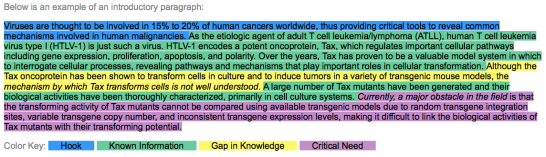
Science writing is just like all other writing! The topic and types of evidence used are just different.
Science and writing are two of my biggest academic interests, so I was excited to get to combine them a lot more this semester. As I look toward writing my senior thesis next year, I’m excited to further utilize and refine the skills I’ve been practicing this semester.
4. There’s a gene called capicua that is implicated in neurodevelopmental disorders such as ADHD and Autism, and we can use stem cells to learn more about it.
This semester, I joined a lab at Massachusetts General Hospital that uses stem cells to study psychiatric and neurodevelopmental disorders. My project in the lab, which will eventually make up my senior thesis, is really fascinating.
Early last fall, the lab received skin cell samples from a patient with Autism Spectrum Disorder, intellectual disability, and recurring seizures. The patient was genotyped and it was found that a mutation she carries in a gene called Capicua (or CIC, for short) may be at least partly responsible for these symptoms. Normally, CIC encodes a protein that controls the expression of other genes important for central nervous system development. We hypothesize that when CIC is mutated, its ability to regulate these other genes may be hindered. To test this idea, my lab reprogrammed the patient’s skin cells into induced pluripotent stem cells and, starting this summer, I will be growing the stem cells into neurons to observe the cellular and molecular level effects of the gene mutation on human neurons.
What interests me most about this project is that the stem cell technology I’ll be using only really became advanced enough for such investigations in roughly the past decade. After just one semester in the lab, I’ve already learned quite a bit about genes, proteins, and the molecular techniques used to understand them—and I can’t wait to continue to learn more as I carry out the rest of my project.
5. The Isabella Stewart Gardener Museum and the Museum of Fine Arts are beautiful places that every college student in the Boston area should visit at least once.
I’ve been living in Massachusetts since I was four years old, but for some reason, I had never gone to the Isabella Stewart Gardener Museum nor the MFA until this past weekend, on the last day of the semester. One of my friends really wanted to see a temporary Botticelli exhibit at the ISG, so I ended up going with her and another friend.
The ISG had such an interesting, eclectic mix of art from around the world. The central courtyard, pictured below (though I don’t think my photos really do it justice), was beautiful and tranquil. The Botticelli exhibit they had was about violence against women in his art—a topic that, unfortunately, as the exhibit descriptions pointed out, still holds relevance today.


The courtyard at the Isabella Stewart Gardener Museum in Boston
There were some fascinating exhibits going on at the MFA, as well. We saw one on Frida Kahlo, which definitely brought me back to last summer when I was in Mexico, as well as one on fashion and gender expression. My friend who had wanted to see the Botticelli exhibit apparently also knew a lot about Japanese Buddhism from a class she had taken last year, so she taught us a lot about Buddhist art and culture in the Art of Asia section of the museum. I definitely hope to go back to both places sometime this summer to check out the other exhibits we didn’t have time for.
—-
Overall, this semester was a challenging one, but also one filled with academic and personal growth. With summer underway, I’m now looking forward to enjoying warmer weather, less stress, and a lot more blog post writing!
 On Ariel's Mind