
“If I’m gonna tell a real story, I’m gonna start with my name” – Kendrick Lamar
Names are an important part of our identity. Some names carry with them centuries of family history, challenging the person who now holds the name to live up to the legacy of an ancestor or embody certain personal traits. Other names hearken back to a specific time period or place—think Genevieve and 1920s France, for instance. Still, others are entirely unique, either in their spelling or pronunciation or origin. All names, however, tell a story. Here’s mine:
My first name is Ariel, which in Hebrew means “Lion of God.” Ariel is also one of the names used to refer to the city of Jerusalem in the Torah and is the name of a spirit in Shakespeare’s The Tempest. I think my parents picked it for me because it sounds vaguely like the first name of a distant relative—a great, great grandfather I think, though I’m not too sure—and because it was a popular boys’ name in Israel back in the ‘90s.
I’ve always been proud of the meaning and origin of my name. Having a Hebrew name makes me feel more connected to the Jewish faith and to Israel, where I was born. And of all the animals I could have been named after, what better than a lion—the king of the jungle! Call it corny, but I’ve always felt a weird connection to the movie The Lion King because of my name’s meaning. When I lost my dad at age twelve, about a month before my Bar Mitzvah, I told myself to be brave like a lion: if Simba could learn how to be king of the jungle after his father died, then maybe I could go through my Bar Mitzvah and learn how to be a man without mine.
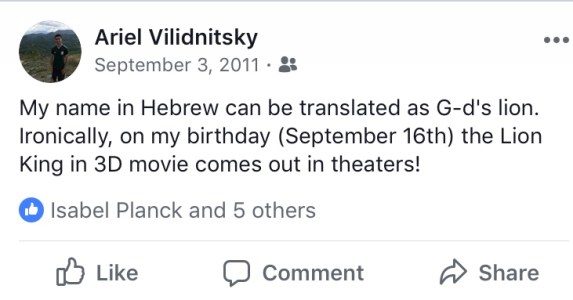
Let’s ignore the fact that I didn’t seem to know the definition of ironic in 8th grade 🙂
As proud as I am of my name’s meaning and origin, however, there are parts of it that I don’t like as much. I’ve struggled with people mispronouncing my name pretty much my whole life. I remember once introducing myself to someone in college and them responding with, “Wow, I’ve never heard that combination of letters pronounced like that!” I think that’s the reaction a lot of people tend to have when I first tell them my name, even if they don’t exclaim it as emphatically as that one guy did.
I pronounce my name aw-ree-el (like if you were to say the letters R-E-L), but most people expect it to be pronounced air-ee-ull. To be fair, I don’t actually know how I learned to pronounce my name the way I do. I guess it must have been how my teachers in preschool said it or something, because my own family usually called me by the Russian variant of my name, which is similar but not exactly identical to the English pronunciation. The Hebrew pronunciation of Ariel is very close to how I pronounce it in English, though, which is why I continue to say my name the way I do. I mostly blame the movie The Little Mermaid for all the pronunciation issues people have with my name. The characters in the movie refer to the protagonist by the air-ee-ull pronunciation (or the “girl version,” as people would say in elementary school), and now pronouncing Ariel in that way is so ingrained in American culture that people are thrown off when I tell them my name is R-E-L.
Watch from 1:15 to hear how Sebastian pronounces Ariel the same way I do, while Eric pronounces it the “mermaid” way. This is also a pretty accurate depiction of every conversation I have ever when I introduce myself to someone.
One good thing about having a difficult-to-pronounce name, though, is that you learn who your true friends are: the people who get more defensive about other people mispronouncing your name than you do yourself. Junior year of high school, for example, I had a statistics teacher who always pronounced my name the mermaid way. I had known her since freshman year, but I wasn’t assertive enough to correct her beyond the first couple of times that she mispronounced my name, so by junior year the wrong pronunciation had stuck and I felt like it was past the socially acceptable period of time to correct her again. To combat this, any time the teacher would refer to me in conversation with one of my friends in the class, they’d passive aggressively correct her by dramatically pronouncing my name the correct way. Here’s a sample dialogue of how it would usually go down:
TEACHER: Who are you working with for the midterm project?
FRIEND: I’m working with Ariel.
TEACHER: ….?
FRIEND: ….
TEACHER: Ohh! Air-ee-ull.
FRIEND: Yeah, R-E-L.
That high school example is a more extreme case, but I think it illustrates an interesting trend that people who care a lot about me tend to also care a lot that my name doesn’t go mispronounced. It’s honestly pretty touching when I hear people defending my name to someone else, and it’s something I want to get better at doing for other people who have similarly hard-to-pronounce names.
Pronunciation issues only really occur in the U.S., though. In Israel, obviously, everyone is familiar with the name Ariel (one of the prime ministers several years back was even named Ariel) and it’s a lot more common for men to have the name. Interestingly, Ariel is actually also a decently common name in Latin America. Freshman year of college, my Spanish class read the play La muerte y la doncella (Death and the Maiden), which was written by Argentine writer Ariel Dorfman (who, to clarify, is a man). When I lived in Mexico this past summer, people always got my name on the first try and usually understood what I was saying when I would introduce myself—a refreshing change of pace for sure.
When your name is three syllables or longer, you tend to get nicknames growing up, whether or not you ask for them. The most common nickname for Ariel is Ari, but my mom never really wanted me to go by Ari as a kid because the “-el” part of my name means God in Hebrew and she didn’t want that part of the meaning chopped off. So, I generally stuck with Ariel and that’s how I always introduce myself now. Nonetheless, there are people who will insist on calling me Ari. Growing up, these people were usually P.E. teachers or tennis coaches, but occasionally there would be a camp counselor or just someone who thought they were too cool to say the last two syllables of my name who would also try to refer to me by that nickname. At this point, I’ve gone by Ariel for so long that I really don’t feel like an Ari, though I don’t necessarily mind as much as I used to if people try to call me Ari. Sometimes, I’ll even try to be cool and tell the Starbucks barista that my name is Ari so that they’ll spell it right. But because I’m so used to saying Ariel, I’ll forget to stop talking after “Ari” and will end up saying something like “Ari-eh…,” then catch myself before I say the last letter. But by that point, I’ve already confused the barista more than if I had just said my full name, so I don’t really know how effective that trick is.
I think about my name and its meaning, mispronunciations and nicknames often because it’s so central to my identity. There’s a lot I could say about my middle and last name, too, but I think I’ll save those for another week’s blog post. In the meantime, if you have a cool name story (which, honestly, I think everyone does, even if they don’t admit it), I’d love to hear it. Comment below, message me, or start a blog and write a response piece! Names tell a story—this was mine, and I can’t wait to hear yours.
 On Ariel's Mind
Thanks for sharing On Ariel’s Mind with me – I thoroughly enjoy reading your blogs – and want to wish you and your wonderful family (now you are an uncle as well) – S’Novim Godum – a year filled with only good things!!
LikeLiked by 1 person
Thank you so much, Myrna!! It means a lot. Happy New Year to you and your family as well 🙂
LikeLike