
Growing up, I used to attribute my appreciation for math and science to my dad, who worked pretty much his whole life as a civil engineer, up until his death in 2010. At home, Dad was the one who helped me build things with my Lego and K’Nex sets. He was also the one who patiently taught me long division after several poor exam scores in the fourth grade made me frustrated with math. Dad loved to measure, calculate and create, and he tried to instill this passion in me and my brother.
Though I so often thought of my dad as the science person in the family, looking back on it, I think a lot of my love for stories and storytelling actually also came from him. Unlike me, my dad was a pretty extroverted guy. He may have struggled the most with English out of everyone in our family, but he was also the one who could most easily strike up a conversation with just about anyone, regardless of language or cultural barriers. At family gatherings, he was often the center of attention because of the funny, insightful, and at times outright crazy stories he would tell about his life.
It was through years of listening to my dad tell his fascinating anecdotes that I eventually learned for myself just what goes into crafting and conveying an interesting story.
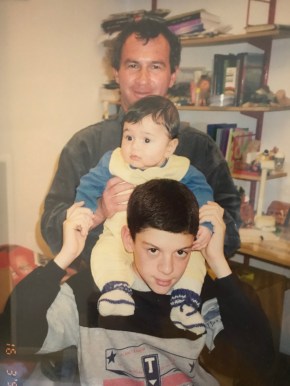
My dad, my older brother and me, back when I was a baby and we lived in Israel. If the date on the photo is correct, it was taken on my brother’s 14th birthday, which was also my 6 months birthday.
* * *
I learned pretty early on that embedding humor into a story can make it both more captivating and more memorable. Many of Dad’s stories were funny ones; he would poke fun at himself and his friends, as well as at bureaucracy. He especially loved when his stories included an element of dramatic irony.
A classic example of one of his comical stories is about how my family immigrated to the United States in 2001. The story starts with my family flying to the U.S. with our pet dog, a boxer named Aza. Because Aza was too large to fit in the cabin of the plane, she had to travel as checked cargo, meaning we would drop her off at the animal services desk in Israel before our flight, then pick her up again when we landed in the U.S.
Things had seemed to go pretty smoothly at the airport in Israel; all of Aza’s paperwork was in order and her cage was taken along with the rest of the animal cargo to board the plane. When we landed in the U.S., however, we couldn’t seem to find her anywhere. After asking several airport employees—a tough feat in and of itself, given my parents’ broken English at the time—we were eventually directed to find a representative from El Al, the Israeli airline we had flown in on.
My dad found a representative and began carefully explaining to her, in Hebrew, exactly what the problem was. He clarified what flight we had been on, described what Aza and her cage looked like, and even pulled out copies of Aza’s travel paperwork. The El Al rep nodded along attentively the whole time, waiting for my dad to finish his explanation.
Then came the funny part. When he finally did finish, about five minutes later, she smiled awkwardly and, in English, confessed, “Sorry, I actually don’t speak Hebrew! Could you repeat all that in English?” My dad felt like a fool! He had embarked on a lengthy monologue in Hebrew about his missing dog and the El Al employee listening to him didn’t even bother to stop him when she realized she couldn’t understand a word of what he was saying.
Thankfully, things turned out alright. My dad didn’t even end up having to re-explain himself in English because, right then, a TSA agent wheeled out Aza’s cage along with some of the other animal cargo, and we were promptly reunited with her.
* * *
But good stories, as I learned from other anecdotes of my dad’s, require more than just good jokes. They also need to have compelling characters. One character that came up in a few of my dad’s stories was a friend of his from the Soviet Union who worked as a venereologist—that is, a doctor who specializes in treating sexually transmitted infections. This doctor friend, whose name I never actually found out, was somehow always getting my dad out of tough situations at work.
In one venereologist-featuring story, my dad was working as the project manager for a fairly routine construction project in Kazakhstan when one of his workers, through no fault of my dad’s, got injured on the job. As the person in charge of his team, my dad was being held responsible for the incident by the government, who threatened to fire him for it (This was an especially serious threat at the time because government corruption meant that the Soviet Militsiya, or police force, could prevent you from ever joining the workforce again, without much of a trial, even for a minor incident that wasn’t your fault).
Ironically, however, it was government corruption that ultimately got my dad out of this precarious situation. One of the many jobs of the Militsiya, besides investigating work-related injuries, was shutting down underground brothels, which were illegal in the Soviet Union. The Militsiya men, however, often slept with many of the women who worked at the brothels before officially shutting them down. As a result, many of the Militsiya men would end up patients at my dad’s venereologist friend’s clinic.
When my dad’s friend heard about the trouble my dad was in, he called up the head of the Militsiya and told him that he would no longer treat any of the Militsiya men (or, in his colorful words, that he’d “leave them all to rot to death from their STIs”) if they didn’t immediately close the case against my dad. Luckily for my dad, his friend’s threat worked and my dad got to keep his job.
But that wasn’t the only time the venereologist proved his loyalty as a friend! A few years later, when my parents were getting married, my dad tried to take time off from work for his wedding. He was still working as a project manager, this time for the construction of one of the largest government-operated preschools. Apparently, this project was a really big deal, because everyone was expected to work six days a week, with only Sundays off and without the possibility of vacation days.
This was an issue, as my dad needed at least a week off in the middle of the project for his wedding. That’s where the venereologist came in. My dad’s friend ended up writing him a doctor’s note saying that my dad had been diagnosed with gonorrhea (he didn’t actually have gonorrhea) and that he would need a minimum of two weeks off from work to recover. The two week medical leave gave my dad plenty of time to get married and return to work without anyone noticing.
* * *
My dad had a lot of wild stories from his time living in the Soviet Union and then Israel, but some of my favorite stories of his were actually ones that were about small, everyday situations. These narratives taught me that a good story, above all, should be relatable.
The story of his that I remember best is one that indirectly involves me. In third grade, I begged my parents to throw me a birthday party at the local Suburban, an athletic club similar to the YMCA where children would often have those birthday parties where you awkwardly play dodge-ball for the first hour as guests arrive, then go swimming in the indoor pool, then end by eating pizza and ice cream cake in a small function room at the back of the building. Much to my surprise, my parents actually agreed to the idea.
My dad was in charge of calling Suburban and coordinating the party logistics with them. Since he worked 9 to 5 every day, he had to make the call from work at one of the construction sites he was managing. The phone call, according to him, went well and we were all set to have the party.
About a week later, my dad drove over to Suburban to pick up this informational folder they provide for all party hosts. When my dad told the employee at Suburban the name under which our reservation had been made, however, the employee told my dad he couldn’t find any folders with that last name. My dad was certain that he had made the reservation and insisted that the employee look more carefully.
The employee looked around everywhere, but he couldn’t seem to find a folder for “Mr. Gregory Vilidnitsky.” He did eventually, however, find one for a “Mr. Gregory Zilidogmitsky”…
Turns out, the employee with whom my dad had made the reservation had completely misunderstood my dad when he spelled out our last name on the phone. My dad had been standing outside a noisy construction zone and, with his thick Russian accent, his V sounded like a Z and his N, an M. But why the “dog” in the middle? My parents used to do this thing where they would match each letter of our last name to a word that started with the same letter just to make sure the person on the other end understood what they were saying. It would sound a bit like: “V as in Victor, I, L as in loud, I, D as in dog…” Clearly, their strategy backfired this time, because the employee must have missed the “D as in” part of my dad’s spelling and just heard “dog,” which he comically inserted into the middle of our last name.
After clarifying the mistake, my dad was able to pick up Mr. Zilidogmitsky’s folder and, from there, the party went as planned, without any hitches.
* * *
My dad has been gone for almost nine years now, but the stories he loved to tell—and told so well!—have continued to live on all these years. Whether he ever realized it or not, the attention to detail and humor my dad weaved into each of his stories inspired me to want to be a better writer and a better storyteller myself. Today, his stories serve not only as a testament to the extraordinary life he lived, but also to the immense passion he had for sharing his adventures with the friends and family he loved.
—
This blog post is part two of a three-part series I’m working on in the month of June about my experiences with writing and communication. To see part one of the series, entitled “On Writing,” click here. To read part three, click here.


Ariel, I read all of your blogs. Thanks for sharing your father’s stories with us. I remember that your Dad (Aba, Papa) helped me when my husband was very ill in 2003 and he died in 10/2003. . I needed someone to be with him while I had to go to work at JFS as I carried the medical insurance for our family and he was not able to work.. Your Dad and one of your grandfather’s who was visiting from Israel (I think he was an electrician in Israel) were able to paint several rooms, hang a fixture, and check on my husband every 15 minutes. I had peace of mind to be able to go to work for a few hours, and know that he was being cared for if he needed any assistance. You have wonderful memories to share with your children someday. May your Father’s memory be a blessing for all his family.
LikeLiked by 1 person
Thank you, Myrna, for reading and for sharing that lovely memory! I really appreciate it.
LikeLike