
When I first started On Ariel’s Mind a little over a year ago, it was primarily as a way to put my money where my mouth is. I wanted to finally take the initiative to do independent, creative writing for myself, especially after years of claiming that writing is a “passion” of mine with very little non-academic written work to show for it. I didn’t know where blogging would take me, but I did know that I was excited to finally have a platform to share all of the ideas that had been floating around in my mind, unwritten.
With one year down, I can say with confidence that this project has definitely been worthwhile. Writing new blog posts hasn’t always been easy, but it has always felt rewarding. I sincerely believe that I’ve grown a lot, as a person and as a writer, because of this blog.
As with any project, I think it’s important to pause from time-to-time to take stock of what you’ve accomplished and outline what remains to be expanded upon or improved. This week seems as good a time as any for this sort of reflection.
Going into year two of blogging, here are my observations and thoughts on the experience thus far:
- Writing every week is hard!
It’s no secret that I broke my weekly Sunday blog post deadline more than a couple times this year. School work gets stressful, writer’s block hits, and sometimes, I just don’t have it in me to finish a blog post in a given week (or even in a given couple of weeks). This past summer especially, I hit a period of time where I was just struggling to get any posts out at all. I had ideas for what I could write about, but every time I sat down to actually write, I struggled to formulate a coherent thought. I published new posts only about once every three weeks and even then, I wasn’t entirely satisfied with my final product. Feeling like I lost my writer’s “touch” was certainly stressful, but I think it’s also probably an inevitable part of any writer’s career. Hopefully, the time I took to slow down a bit over the summer will help me come back stronger this fall and winter.
It’s always hard to gauge how long writing a new post will take in any given week. On one extreme, I wrote “On Making Wishes” in a little under 2 hours late one night before bed, after suddenly being overcome by an urge to write. Athletes and musicians often talk about being “in the zone” when they perform at their best and I think that’s how I felt, too, as I was churning out paragraph after paragraph almost effortlessly. On the other end of the spectrum, “On Communication” took me over 2 weeks of on-and-off writing; I think I wrote at least ten different introductory paragraphs for that post before I finally settled on one good enough to allow me to move forward with the rest of the piece.
Though I ultimately fell short of my 52 blog posts goal, I am happy to report that I wrote 31 posts this year, which is no small feat. Going forward, I think a more attainable goal for the coming year will be to post once every 2-3 weeks, rather than once a week. On weeks that I don’t post, I will stay engaged with my blog by updating the Quote of the Week page. I started neglecting this section of my website last spring because it was becoming too time consuming to write both a longer post and a shorter close reading of a quote. Alternating between writing full posts one week and writing shorter quote analyses other weeks will hopefully be more sustainable.
- Concision is still something I need to work on…
The biggest piece of feedback I get from readers, and especially my family, is that I need to make my blog posts more concise.
Concision issues can stem from a variety of sources. Sometimes, the problem is that the topic I’m writing about is too broad. This comes up a lot when I try to write personal narratives that span too long a period of time, such as “On Being Jewish” or “On Mamma Mia!”, which trace my entire life’s experience with a certain topic. An interesting suggestion my brother gave me is to break up such longer posts into a Part I and Part II. This is something I’ve tried a couple times now, particularly with my posts about song lyrics and television. One downside, however, is that the Part II posts have tended to get fewer views than their corresponding Part I. Perhaps a solution is to not post the Part I and Part II on back-to-back weeks, but instead to separate them with a few blog posts on unrelated topics in between. That way, readers don’t get bored following the same subject for multiple weeks.
Other times, however, concision issues are the result of poor editing. Every writer is introduced at some point to the phrase “kill your darlings.” This quote, often attributed to Faulkner, means that a writer must sometimes get rid of (“kill”) pretty-sounding sentences (their “darlings”) if the sentences don’t actually add any important content to the work they’re writing. While I’ve been trying to follow this advice more, I’ve also come to realize that deleting sentences that I worked so hard to make just right can be disheartening. As a compromise, I keep a separate word document titled “Lines Taken Out of Posts,” into which I cut and paste sections that I need to remove from a post, but that I don’t want to part with forever. This document allows me to reread well-worded lines for my own pleasure, without forcing them into a blog post just because they sound good or because I spent a lot of time on them.
Identifying which darlings to kill is not easy. Sometimes, an eloquent, detailed sentence can actually keep a reader more engaged, even if the sentence contributes little to the essay’s main argument. Recognizing and removing just the right amount of fluffy sentences is a skill I plan to continue honing this upcoming year.
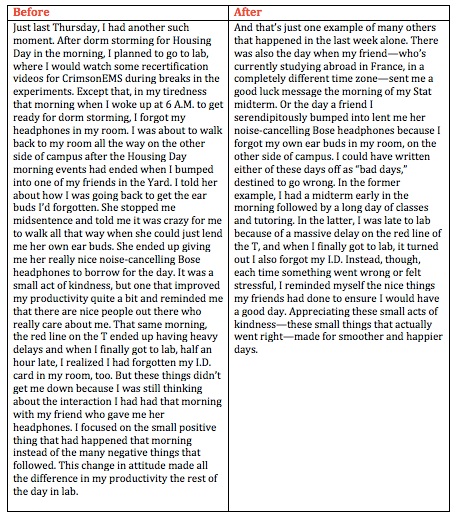
I’m still not great at writing concisely, but I think I have made a lot of progress in identifying unwieldy paragraphs. This before-and-after excerpt, taken from “On The Things That Go Right,” is a good example of a long paragraph that I was able to make more concise. On a side note, I’ve also found that adding more images makes a post feel less long. This comes with the added bonus that I can wrote additional content in the caption of the photo, which readers can choose whether or not they want to read.
- … As are transitions and conclusion paragraphs.
It seems like a subtle part of writing, but the thing that slows me down the most is finding the right transition phrases or sentences to make my paragraphs flow logically from one idea to another. When I really have the time, I can spend hours just working on a single transition between two paragraphs. Transitions are especially tough to write for posts that are more of a list, such as “On Being Small” or “On Social Media,” because I don’t want to just keep repeating “And also…” with each new point. I want one point to build naturally on the previous one.
I think a lot about whether it’s better sometimes to write posts in a bullet point or numbered list format (like this one). For topics that are amenable to such formats, the upside is that I am largely able to avoid the issue of transitions because the bullet points and headers essentially serve as the transitions. I worry, however, that these listicles comes across as lazy writing, or even a cop-out for not having a more coherent idea.
Conclusion paragraphs can also be challenging to write. Often, I’m so excited about having finished writing the main paragraphs of my post that I just want to end the piece already. Yet, I feel this obligation to find the perfect final sentence, something that expounds on a deeper theme I’ve been hinting at all along and has a witty or clever wording to it. It’s hard to find something truly inspired to end every blog post with, and finding the perfect closing sentence is often more a matter of creative luck than skill. As a result, I sometimes publish my posts still feeling a bit dissatisfied with the conclusion paragraph I’ve written, but resigning to the fact that I probably won’t come up with a better way to end what I’ve written any time soon.
- I worry that I come off as too preachy sometimes.
Along a similar vein, I tend to feel the need to end my blog posts with some kind of big take-home message. This isn’t necessarily a bad instinct to have because strong writing should be motivated by some kind of larger implication; there should be something at stake in the argument a writer makes, otherwise, what’s the point of writing?
This line of reasoning generally holds well for academic expository writing (similar to the style of my “On Television” series). There’s a finer line, however, when it comes to personal narratives. I often try to embed some sort of message or life advice in my personal narrative blog posts because I worry that readers won’t care about the story itself unless there’s some kind of eye-opening moral at the end that they can relate to and apply in their daily lives. Adding this final piece of advice also helps me feel less narcissistic, as if a relatable message or piece of advice makes up for spending 1,000 words talking solely about myself.
But do these closing remarks actually make a story better, or do they come across as cheesy, unsolicited advice? Can a personal narrative stand alone, without having an explicit moral laid out at the end, and still be interesting? What about a list-style piece? These are the questions I continue to grapple with when I write.
- Writing isn’t easy, but it is intrinsically rewarding for me and helps me think through complex ideas.
Many of these reflections have been on elements of my writing I’m still trying to improve, but I want to end this post on a slightly more positive note. Throughout this year of blogging, I’ve really come to recognize just how intrinsically rewarding writing can be. No matter how much I struggle with putting together a piece, I always feel a sense of accomplishment and pride once I’ve finally put my ideas down into words and hit the “publish” button on a new post on WordPress. Writing has also proved to be a great way to think through complex problems and ideas. By finding the most convincing evidence, most precise word-choice, and most logical organization to convey an idea, I’m often able to get a lot more clarity about a certain topic than if I just leave it to stir around in my thoughts. Writing helps me really get to the root of an idea.
I want to thank everyone who has followed me throughout this year of blogging. It’s not easy to be vulnerable and to share personal writing with a larger audience, but the support and encouragement I’ve received along the way have really made this experience special. You all inspire me to be a better writer.
Here’s to another productive year of blogging!
 On Ariel's Mind
Keep writing and “pushing “ the publish button! You are getting better with every blog! ❤️
Sent from my iPhone
>
LikeLiked by 1 person
Thank you for your support!!
LikeLike