
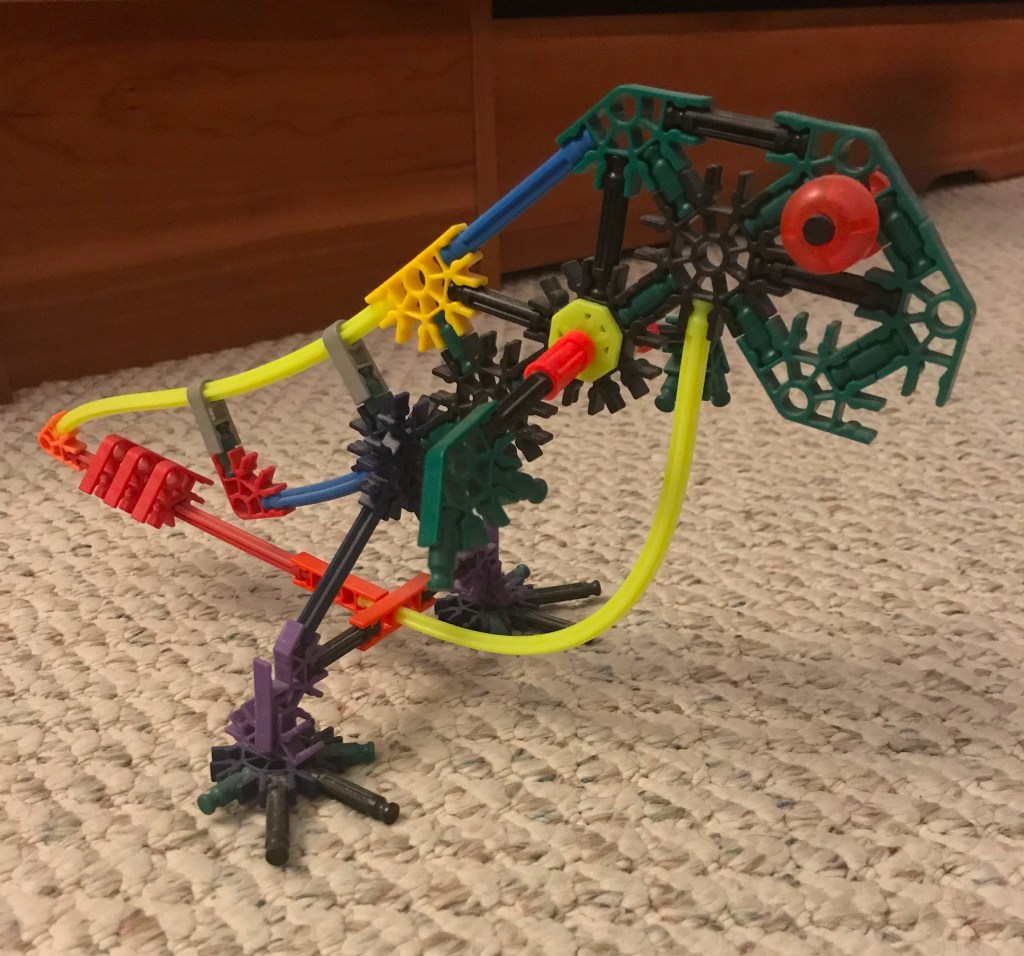
When I was in second grade, my uncle bought me a K’Nex building set for my birthday. One day, while looking through the set’s catalogue, I came to a page with an image of a towering dinosaur made entirely of K’Nex pieces. The dinosaur was intricate and flashy, and I was determined to build it. Much to my chagrin, however, there were no assembly instructions, just a single photograph. I had only ever built simple structures with my set; there was no way I could build this dinosaur alone.
Naturally, I asked my dad, an experienced civil engineer with a passion for building, to help me. Not wasting any time, Dad charted out a plan of action. He counted and laid out all the necessary pieces, and began construction. Truth be told, I could not have completed a single inch of the project without him. Dad knew just which pieces to use, and it all came so effortlessly to him. While I saw a mess of pieces, he saw a fresh slate from which to begin assembling a masterpiece. I gladly took on the role of his assistant, handing him new pieces and offering occasional advice.
After a whole day’s work, we finally finished the project. I was ecstatic! Building the dinosaur had been interesting, but what I really craved was finally playing with it. For me, the dinosaur was a living, breathing creature that transported me into my own imaginary world. I wanted so desperately to know how its mind and body functioned; I yearned to discover the inner-workings of this magnificent creature. Was he a friendly giant or a vicious carnivore? What sorts of thoughts did he have? Dad had seen the dinosaur through the lens of an engineer completing a master project, but I saw it through different eyes. I was a biologist and a psychologist, inspecting this unique organism with eager precision.
For the next year, I subjected the poor dinosaur to hours of poking and prodding. As time went on, however, I slowly lost interest. By middle school, schedules became busier and homework, endless. I had less time for play and certainly no time for long afternoon construction projects; the toy soon became nothing more than a forgotten shelf decoration.
Then, in seventh grade, my life changed forever. That year, my dad was struck and killed by a drunk driver while working on a highway-engineering project. In an instant, I lost my dad, my best friend, and my construction partner.
After his death, many of Dad’s coworkers came to my house to express their condolences. They told me how incredibly sorry they were and that they would keep me in their prayers. Most of all, however, they each had one clear message for me: now that Dad is gone, I should follow in his footsteps and become an engineer.
Before long, it seemed like they weren’t the only ones telling me this. Aunts, uncles, and family friends began echoing the same sentiment at just about every family gathering. Engineering, they claimed, was stable and admirable: the perfect career for me.
These words really got to me. I didn’t want to be an engineer, yet I felt as though I was letting so many people down by having a different vision. Even worse, I feared I was disappointing Dad, who had always been so passionate about his job. I tried to like engineering; I even enjoyed my math and physics classes in school. Still, I loved biology, statistics, and language even more. Designing and building construction projects didn’t make my eyes light up with excitement the way Dad’s did.
For years, I struggled with these expectations as I searched for an identity that would please my dad, his co-workers, and everyone else. Then, one summer just before tenth grade, I found a small figure made out of K’Nex pieces behind a bookshelf in my room. It was one of my dinosaur’s arms! I quickly scavenged through my old toys and found the rest of my dinosaur’s pieces. I sat for a while, reassembling the scattered pieces and recalling the day Dad and I had built the magnificent creation. I had loved helping him build it; as his assistant, I was so important and official. But I had loved playing with the dinosaur afterwards even more, giving it life and feelings. Dad had made the dinosaur useful; I had personified it.
Today, there sits a foot-long toy dinosaur on a bookshelf in my room; it is a reminder that I am not an engineer, nor was I ever supposed to be, at least according to Dad. My whole life, Dad had built me a foundation to be whomever I wanted, yet I had confused his intentions with those of all the voices around me. Dad always knew that I saw the world differently from him. He had witnessed all along how my eyes lit up when I played with that dinosaur; I was meant even then to be a biologist or a psychologist, a researcher of my own kind. As I enter college this coming fall with the intention of studying neurobiology, I can proudly say I have discovered my own strengths and passions, which are so different from Dad’s, and yet shaped so heavily by him. With the foundation Dad built me, I can now pursue my own interests, see through my own lenses, and tackle my own dinosaurs.
– – –
I wrote this essay my senior year of high school and submitted it as a supplemental piece for my Harvard college application. With today marking the first Father’s Day since I graduated college, it seems like a fitting time to reflect on this story once more. Four years later, I can say that I did indeed end up studying neurobiology in college; I also continued to pursue coursework in statistics and languages and conducted research as an undergrad. With that said, though, there were definitely many new interests and parts of my identity that I discovered for the first time in college. For example, it wasn’t until my sophomore year of college that I decided I actually wanted to pursue medicine as a career, rather than research. In some ways, I think my assuredness in the statement “I can proudly say I have discovered my own strengths and passions” was perhaps a bit too extreme for someone who was only a senior in high school. I think the overall sentiment of the piece, however, still holds today.
 On Ariel's Mind
This was beautifully written, Ariel! I’m sure Harvard was impressed by the eloquence, too. Thank you for sharing this story with us.
LikeLiked by 1 person
Thank you for reading!! 🙂
LikeLike
Still one of my favorite things you’ve written
LikeLiked by 1 person