
Let’s face it; we’ve all been there. You get into bed, ready for a full 8 hours of sleep after a long, hard day. You’re just about to drift off when… BOOM. Suddenly, your brain hits you with the deepest, most existential questions you could possibly come up with:

Meme courtesy of this Buzzfeed Pinterest page.
Everyone has their own thought-provoking questions that keep them up at night. This week, I’ve decided to share five of my silliest ones. Answers to any of these would be much appreciated!
- Why did they get rid of my favorite iPhone emoji?
Back in the early days of Apple iOS 9, there used to be an emoji that was a combination of “Grinning Face with Smiling Eyes” and “Grimacing Face” (see images below). This emoji was my go-to reaction for at least half the messages I would send because it was perfect for making sarcastic remarks and complaining about minor inconveniences. In particular, I liked that the mouth expressed frustration while the eyes softened that frustration, as if to say, “I’m mad, but don’t take me too seriously.”
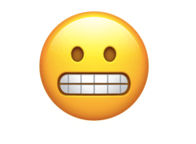

The emoji on the top is “Grimacing Face” and the one on the bottom is “Grinning Face with Smiling Eyes.”
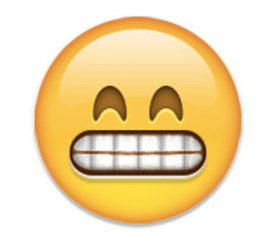
My favorite emoji, which was removed in the iOS 10 update.
The iOS 10 update, which took place in 2016, removed this emoji from the lineup of choices. At first, I was pretty upset; ironically, the emoji would have really come in handy to express that frustration. Four years later, however, I’ve since found substitutes for my grimacing face – smiling eyes man, such as the winking face with its tongue sticking out. Still, it doesn’t quite feel the same without him. His replacement—“Grinning Face with Smiling Eyes” from above—has its own uses. For instance, it’s great for feigning naiveté. But I continue to hold onto the hope that, one day, a future Apple software update will bring back my favorite emoji. In the meantime, I still wonder why they got rid of him in the first place.
- When Lady Gaga sings “It doesn’t matter if you love him or capital h-i-m” is the second him supposed to be written as “Him” or “HIM”?
Okay, so you know that 2011 Lady Gaga song called “Born This Way”? (Of course you do; it’s practically a classic at this point). Well, you know how in the opening line of the song she sings, “It doesn’t matter if you love him or capital h-i-m”? In this lyric, is she trying to make the distinction between “him” and “Him” or “him” and “HIM”?
The way I’ve always interpreted this line is that the first “him” is a human man that the listener loves, such as a boyfriend. Meanwhile, the “capital h-i-m” refers to God. I know God is not necessarily a man, but pretty much all English translations of Judeo-Christian texts that I’ve seen use he/him/his pronouns as the default for God. Thus, it would be reasonable to assume that Lady Gaga would follow the same convention, if only for clarity.1
If that’s the case, I would think that the lyric should be written as: “It doesn’t matter if you love him or Him.” This is because all of the religious texts that I’ve seen capitalize only the H in he/him/his when referring to God. For over 8 years, whenever I heard that line in the song, I would always picture the lyric as “Him” in my head. Earlier this year, however, I decided to look up the lyrics of the song for an unrelated reason and noticed that most lyric websites—including my go-to site, Genius—wrote the opening verse as “H-I-M.”
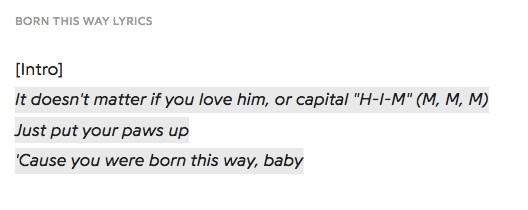
The lyrics to “Born This Way,” according to genius.com
This totally threw me off. Does this mean that Lady Gaga is actually trying to say “It doesn’t matter if you love him or HIM?” If so, to whom does “HIM” refer? Is it still God? I’ve never seen HIM used in religious texts, just as I’ve never seen God’s name itself written as GOD, but perhaps religions other than Judaism do use this convention. Or maybe, it’s that HIM is actually a euphemism for something else entirely. Alternatively, it could also be that lyric websites capitalize h-i-m because H, I, and M refer to the names of the letters, so they should be capitalized as proper nouns. In this latter scenario, it could still be that the “capital” part only applies to the H, so that when you put it all together you still get “Him” as before.
At its core, I guess this issue is no different than having misplaced parentheses in math. Just as how y = sin(3x) + 5 is a different equation from y = sin(3x + 5), capital(h)-i-m has a potentially different meaning from capital(h-i-m). If you’ve got any ideas regarding which one Lady Gaga actually means, let me know!
- When you bite your tongue or gum while chewing, why do you inevitably end up biting the same spot over and over again with each subsequent chew?
Maybe this is just a me problem, but do you ever accidentally bite the inside of your gums or your tongue while chewing? For me, whenever this happens, I inadvertently end up biting the same spot over and over again the rest of the meal, no matter how hard I try to chew more slowly and carefully.
I’ve always wondered if there’s a reason why this happens. Is there something about making the initial bite that leaves some sort of scar that then makes this region of my mouth more susceptible to subsequent bites? Is it just that the first bite leaves me in such a stressed mood that, no matter how hard I try, I just won’t be able to chew carefully enough to avoid further nicks? Am I just bad at chewing?
Whatever it is, it’s a pretty frustrating phenomenon. Maybe knowing why it happens will help me prevent it in the future.
- Why is Antoni the “food and wine” expert on Queer Eye if he rarely gives any advice on wine selection?
My favorite quarantine hobby so far has been binge-watching episodes of the Netflix series Queer Eye. For those unfamiliar with the show, the premise is that a group of 5 gay men, known as the Fab 5, visit the homes of everyday people to give their lives a full makeover, from redesigning their house to giving them a new haircut. Each member of the Fab 5 has his own specialty; for instance, Tan France is the “fashion” expert, while Karamo Brown does “culture” (which means that he’s more-or-less a life coach/therapist).
Like just about everyone else who has ever watched the show, I quickly fell in love with Antoni, the charming “food and wine” expert. But now, having finished the first four seasons of the show, I have to admit that I’m confused why Antoni is explicitly the food and wine expert. Of the 30+ episodes of the show that I’ve seen so far, Antoni has only ever given advice on wine maybe twice, and if I remember correctly, one of those times was just him explaining the difference between a red wine glass and a white wine glass. There was one other instance, which was part of the show’s four-episode miniseries filmed in Japan, during which Antoni showed someone how to make a cocktail, but the drink contained no wine in it anyway.
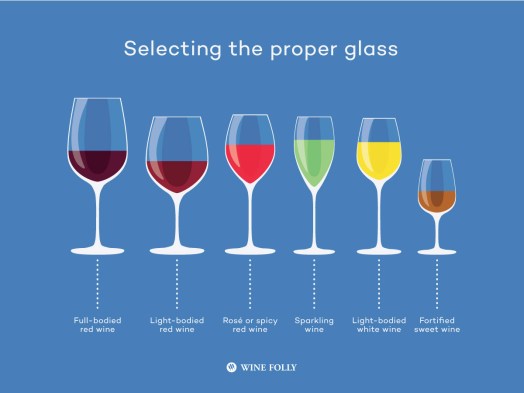
It turns out, picking the right wine glass is actually a lot more complicated than it sounds! Image found here.
Antoni is the only member of the Fab 5 who has a two-part descriptor. The show doesn’t call Johnathan the “hair and skincare” expert, even though he coaches people on both; instead, he’s the “grooming” expert. Maybe Antoni’s role is described with two words because there’s no one word that properly encapsulates both food and drink—but in that case, why don’t they call him the “food and drink” expert, since he gives suggestions on beverages other than wine as well? Does wine just sound fancier (or, more “elevated” as they would say on the show)? Is the name just a relic from the original Queer Eye show that was aired on Bravo from 2003-2007? Did Ted Allen, who held Antoni’s role in the original series, do more advising on wine?
Queer Eye producers, if you’re out there, please let me know! Or at least add more wine consultations to season 6 to make up for this.
- Why are “men’s” shampoos always 2-in-1?
One of the reasons I like watching Queer Eye so much is that I often learn really useful tips from the show. For example, I learned from Jonathan that shampoos that contain sulfates—chemicals such as sodium lauryl sulfate and sodium laureth sulfate, which give your shampoo that “lather” texture to it, as well as help break up dirt and oil—can be irritating to your scalp. As a result, some experts recommend using sulfate-free shampoo.
I spent this past week researching different types of sulfate-free shampoos in an effort to try one out and see if it works better for my hair. In the process of researching, I was reminded of a question that comes to mind nearly every time I’m shopping for hair-care products: Why is it that shampoos marketed toward men are always a 2-in-1 shampoo/conditioner combination? I’ve personally never seen a shampoo “for men” that doesn’t also contain conditioner; I’ve also never seen a standalone conditioner “for men.”
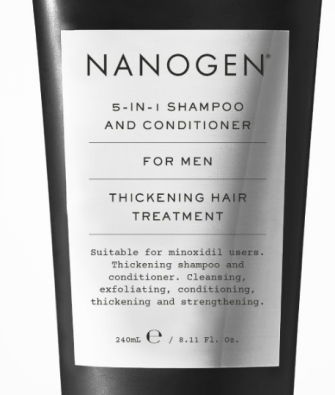
This shampoo is a 5-in-1 product. What even are the 5 components!?
Now, I’m not gonna lie. There is something that feels kind of masculine about doing multiple things in one foul swoop when they really should be done in separate steps. As a kid, I used to always insist on carrying as many groceries as possible in one trip from the car to the house to show off my insane strength (and inevitably, I would drop multiple things before I got to the front door).
But why do shampoo companies assume that men don’t want to condition separately from their shampooing? Is the assumption that men all have really busy schedules and/or hate spending more than the bare minimum amount of time on their hair, so men’s hair-care products should be 2-in-1 to save time? You’d think there would be at least one shampoo company out there that would make a separate men’s conditioner. If they did a really good job marketing the fact that it’s better for your hair to use a standalone conditioner, they could potentially even make more money than the 2-in-1 companies. If they made the shampoo and conditioner each the same cost as a single 2-in-1 bottle, they could rake in twice the profit per customer. But no company does.
Maybe the more pressing question, though, is why there are even gendered shampoos to begin with. Is there really much biological difference between men’s and women’s hair that warrants separate product lines? Luckily, this question is actually pretty Google-able, so I decided to search it up. Based on what I’ve read, the most notable difference between men’s and women’s products is fragrance, rather than a difference in active ingredients. The other reason I can think of is that the masculine/feminine labeling appeals to a central part of the consumer’s identity, perhaps motivating them to buy a certain product over others because they see it as being more specifically “for them.”
If anyone—particularly a dermatologist, or at least someone with a biochemistry degree—wants to start a shampoo company, hit me up! I’d like to sell the first-ever men’s conditioner.
– – –
[1] Given that “Born This Way” is about defying societal standards for appearance, sexuality, gender, etc., I’ll admit that this assumption may be invalid. I’m very open to hearing other interpretations of the lyric!


Uncle Jessie on full house used food products as conditioner! There’s an episode where he puts mayo on his hair.
LikeLiked by 1 person
And his hair always looked so good! I’ll have to try it out 🙂
LikeLike